
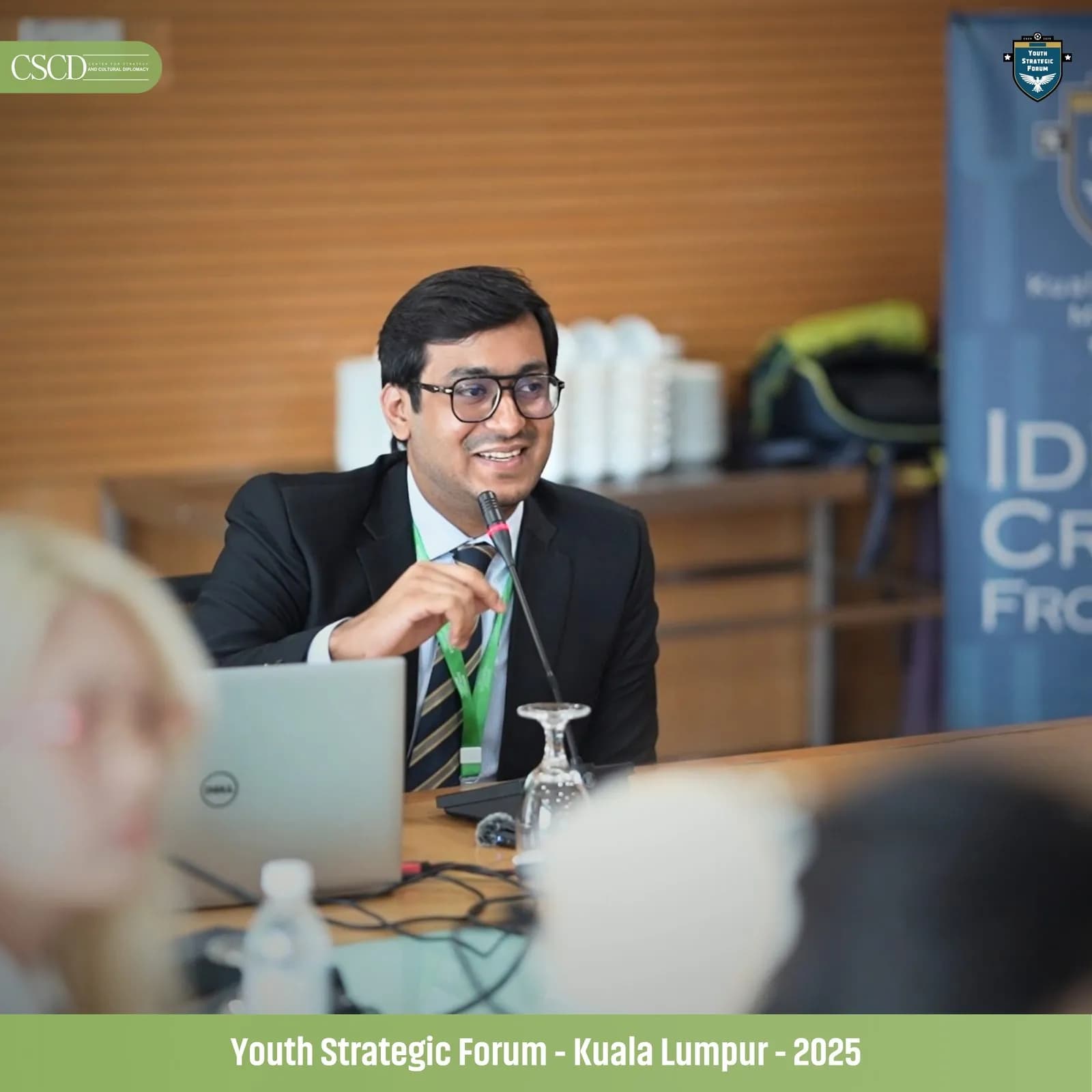
YSF Kuala Lumpur 2025
Kuala Lumpur, Malaysia · January 1–3, 2025
- Date
- January 1–3, 2025
- Venue
- Kuala Lumpur, Malaysia
- Speakers
- Director Hassan Mehar (Executive Director, CSCD) & Isabella Pek (Head of Music, Kuala Lumpur City Hall)
The Youth Strategic Forum (YSF) Kuala Lumpur 2025, convened by the Center for Strategy and Cultural Diplomacy (CSCD), brought together emerging leaders, scholars, and strategic thinkers aged 16–45 to examine critical dynamics shaping 21st-century geopolitics, power distribution, cultural identity, and peacebuilding. Positioned at the geographic heart of Southeast Asia and leveraging Malaysia’s multicultural context and strategic positioning within the Global South, YSF Kuala Lumpur created a comprehensive platform for developing strategic practitioners capable of navigating complex regional and global challenges.
Kuala Lumpur’s positioning as a major Southeast Asian hub provided an ideal setting for examining regional integration, South–South cooperation, and emerging market leadership. Malaysia’s unique multicultural society — encompassing diverse religious traditions, ethnic communities, and political perspectives — offered participants a living laboratory for understanding identity politics, religious diplomacy, and inclusive governance frameworks essential for contemporary strategic practice.
Director Hassan Mehar’s opening address established the forum’s strategic vision, emphasising the importance of developing next-generation strategic thinkers capable of integrating cultural understanding with geopolitical analysis. His sessions examined how strategic thinking requires simultaneous engagement with military power dynamics, economic systems, cultural narratives, and peacebuilding frameworks, demonstrating that compartmentalised analysis produces flawed strategic outcomes.
Isabella Pek, Head of Music at Kuala Lumpur City Hall, demonstrated how cultural institutions function as strategic actors within municipal governance frameworks while serving as platforms for cultural diplomacy and international exchange. Her session on “Art, Society, and Statecraft” examined how municipal governments leverage cultural programming for diplomatic objectives, community cohesion, and international positioning, connecting artistic excellence with measurable strategic outcomes.
The forum’s learning architecture combined fishbowl conversations enabling inclusive engagement with opposing perspectives, Model United Nations simulations developing negotiation and diplomatic protocol skills, and CSCD chapter training equipping local chapters with frameworks for designing strategic cultural diplomacy programmes.
Six modules formed the core curriculum: Art, Society, and Statecraft; Asia’s Identity — Past, Present, and Future; Peace by Peaceful Means; Soft, Smart, and Hard Power; Literature, Poetry, and Nation Building; and State, Military, and Economic Strategy. Additional sessions examined the structure and decision-making of the United Nations Security Council alongside the OIC and ECO frameworks as alternative multilateral platforms supporting South–South cooperation.
Participants developed sophisticated strategic analysis capabilities integrating geopolitical factors, cultural dynamics, economic systems, and historical trajectories into coherent frameworks addressing complex regional challenges. The forum created lasting professional relationships spanning Southeast Asia and beyond, including connections with municipal cultural institutions, and equipped participants to translate analytical insight into actionable governance frameworks that recognise culture’s strategic importance.